


Custom BJJ gis can support academy branding and create a merchandise option. Whether they are worthwhile depends on confirmed unit cost, selling price, sell-through, exchange risk and the supplier’s actual sizing and construction options.
Table of Contents
- Introduction: What Makes A Custom BJJ Gi?
- How Custom Gis Foster Team Unity And Branding
- Customization Options And Their Impact On Cost And Performance
- Financial Implications And Revenue Opportunities
- Checking Durability and Fit
- Common Misconceptions About Custom BJJ Gis
- Ordering Process And Choosing The Right Manufacturer
- Conclusion: Making The Decision For Your Academy
- Enhance Your Academy With Custom Gear From Combatra
Key takeaways
| Point | Details |
|---|---|
| Team identity and branding | Custom gis can create a consistent visual identity; measure any community effect separately. |
| Revenue opportunity | Model revenue from confirmed price and sell-through, then subtract all landed and operating costs. |
| Fit and construction | Confirm size options, measurements, fabric, finished weight, shrinkage and care for the exact product. |
| Customization options | Confirm the exact fabric, embroidery, patches and colour options with the supplier; check current organiser rules separately for competition use. |
| Decision check | Use quotes, member interest, sell-through and full program cost to assess whether a custom-gi program suits the academy. |
Introduction: what makes a custom BJJ gi?
A custom BJJ gi is a martial-arts uniform with selected academy branding or design options. Size, cut, fabric and embroidery choices depend on the supplier and product.
Possible custom-gi options include academy branding, colours, embroidery, patches and, where offered, size, cut or fabric choices. Confirm every option and measurement for the exact order.
Academies invest in custom gis for several strategic reasons:
- Create a consistent academy look through chosen colours and logos.
- Compare the available sizes and cuts for wearer comfort.
- Plan a branded-gear offer using confirmed student interest and a written supplier quote.
- Check current event rules before approving competition artwork.
Custom and standard gis can differ in available sizing, cut, fabric and personalisation. Check the exact size chart, measurement process and sample fit before deciding whether an option suits a wearer or program.
For academies evaluating this investment, custom gis represent a shift from viewing uniforms as basic training requirements to recognizing them as strategic assets that influence culture, performance, and business outcomes. The initial decision to pursue custom gis typically stems from a desire to elevate academy professionalism and create tangible differentiation in competitive local markets.
How custom gis foster team unity and branding
Matching gis can create a consistent academy look at training and events. Ask members for feedback before treating the clothing as evidence of a psychological or community outcome.
Matching academy colours can create a consistent visual identity. See how academies use custom rashguards, and measure attendance or retention effects from your own cohort data.
Branding benefits of custom gis include:
- Use academy-approved colours and artwork for team photos and events.
- Ask permission before using student images in marketing.
- Track enquiries and attributed sales separately from photo views or impressions.
- Collect student feedback before expanding the range.
Matching gear may support team identity. Compare cohort retention and collect student feedback before and after launch.
Hypothetical evaluation: track student feedback, cohort retention, referrals, full program cost and verified contribution margin over a defined test period.
Students may wear academy-branded gis at open mats, competitions and cross-training sessions. Track reach, enquiries and enrolments before treating that visibility as a marketing or reputation result.
Customization options and their impact on cost and performance
Custom gi pricing and performance characteristics depend heavily on fabric choices, design complexity, and order volume. Understanding these variables helps academy owners make informed decisions that balance budget constraints with quality requirements.
Fabric types represent the primary cost and performance differentiator:
- Weave and composition: Compare the exact fabric specification; a weave name alone does not establish weight or durability.
- Finished weight: Ask for the weight of the complete garment in the required size.
- Fit and care: Check the cut, shrinkage guidance and care label on a sample.
- Competition use: Confirm the current organiser requirements for the exact gi.
Embroidery, patches, contrast stitching, linings, labels and construction changes can affect price. Request an itemised quote rather than applying a generic percentage.
| Customization Level | Current Quoted Cost Per Unit | Options to Confirm | Practical Check |
|---|---|---|---|
| Basic | Request current quote | Logo, colours, fabric and minimum quantity | Review artwork proof and sample |
| Standard | Request current quote | Logos, stitching, patches and fabric | Confirm measurements and sample |
| Expanded options | Request current quote | Embroidery, lining, construction and fabric choices | Confirm every specification in writing |
IBJJF competition compliance critically affects design decisions. The International Brazilian Jiu-Jitsu Federation mandates specific color restrictions (white, blue, or black only), patch size and placement limits, and contrast stitching rules. Choosing BJJ gi performance options that meet these standards ensures your students can compete without uniform violations.
Order volume can affect per-unit pricing, but tiers vary by supplier and specification. Obtain written quotes for the quantities and options under consideration.
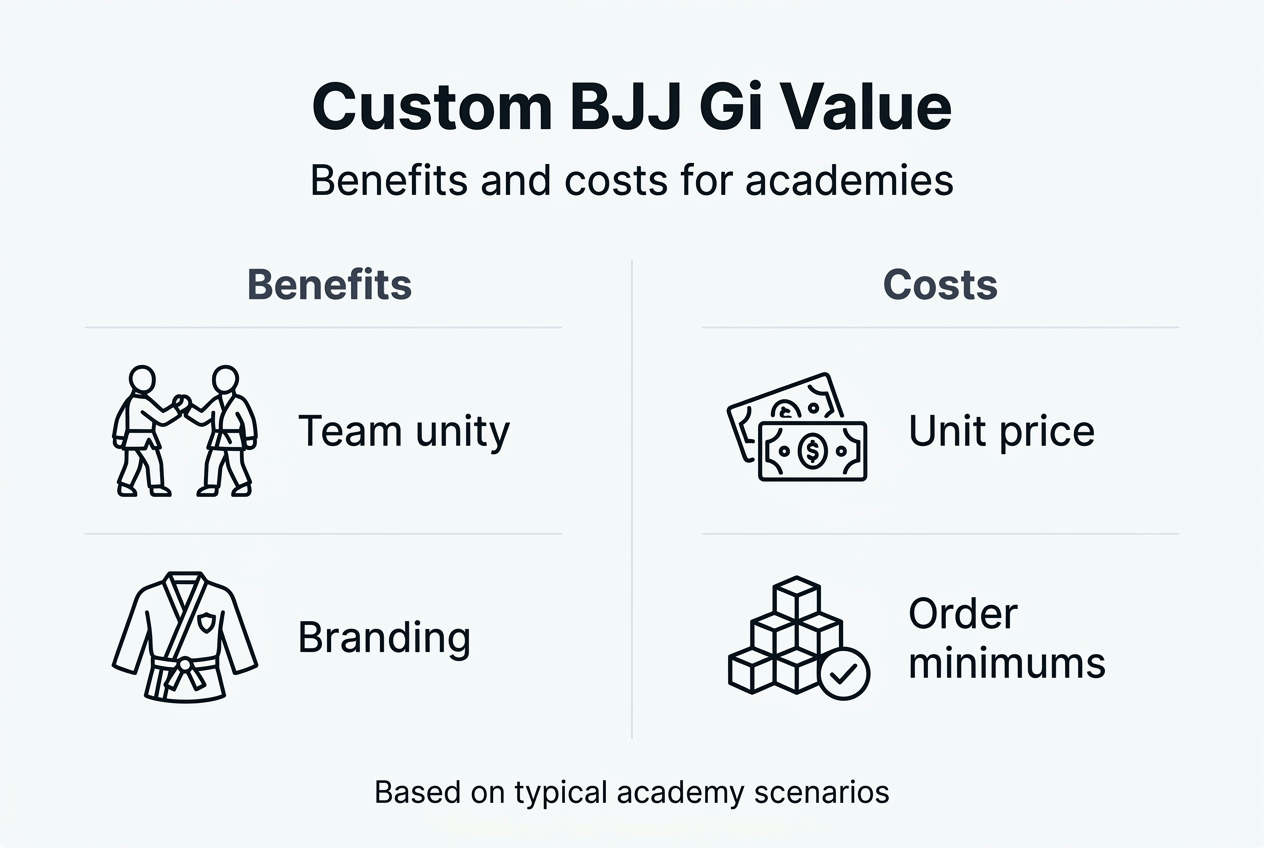
Pro Tip: Request fabric samples and test gis from potential manufacturers before committing to bulk orders. Testing reveals actual weight, comfort, and durability that specifications alone cannot convey. Many manufacturers offer custom blue BJJ gi options in sample quantities specifically for this purpose.
Financial implications and revenue opportunities
A custom-gi program can add merchandise sales. Use the following figures only as hypothetical inputs, then replace them with supplier quotes, actual selling prices and measured sell-through.
Typical pricing structures for custom gis vary by academy size and ordering approach:
| Planning input | How to use it |
|---|---|
| Supplier quote | Include the exact garment, artwork, quantity and any setup charges. |
| Landed cost | Include shipping and other applicable order costs on a consistent tax basis. |
| Selling price and demand | Use the planned price and confirmed pre-orders; do not assume all stock will sell. |
| Gross margin | Calculate (selling price minus unit cost) divided by selling price, using the same cost basis. |
| Program result | Account separately for unsold stock, exchanges, payment fees and other operating costs. |
Revenue opportunities from custom gi programs include:
- Direct sales to existing students as required or optional uniforms
- New student enrollment packages bundling gi with membership fees
- Competition team gear sold to parents and supporters
- Retail inventory for drop-in visitors and trial class conversions
- Online sales to alumni and remote students maintaining academy connections
Calculate merchandise revenue from actual units sold and subtract landed cost, payment fees, exchanges, unsold inventory and staff time. Use your academy’s own figures for any projection.
Recovery time depends on confirmed unit cost, selling price, sell-through and marketing spend.
Hypothetical example: 25 gis at $75 cost $1,875. If 20 sell at $150, cash revenue is $3,000 and cash contribution before other costs is $1,125, with five units still in inventory. If four more later sell at $150, total revenue becomes $3,600 and contribution before other costs becomes $1,725, with one unit still unsold. Use actual freight, tax, fees, exchanges and staff time before calling this profit or ROI.
Hypothetical example: 50 gis at $65 cost $3,250. If 45 sell at $140, cash revenue is $6,300 and contribution before other costs is $3,050, with five units still in inventory. Keep retention revenue out of the model unless cohort data supports the attribution.
Hypothetical example: 100 gis at $55 cost $5,500. If 90 sell at $130, cash revenue is $11,700 and contribution before other costs is $6,200, with ten units still in inventory. Exclude new-member revenue unless intake data verifies the source and contribution margin is calculated.
Checking durability and fit
Custom gi programs can offer selected branding, size or construction options. Confirm the exact supplier specification and collect wearer feedback before claiming fit, performance or durability advantages.
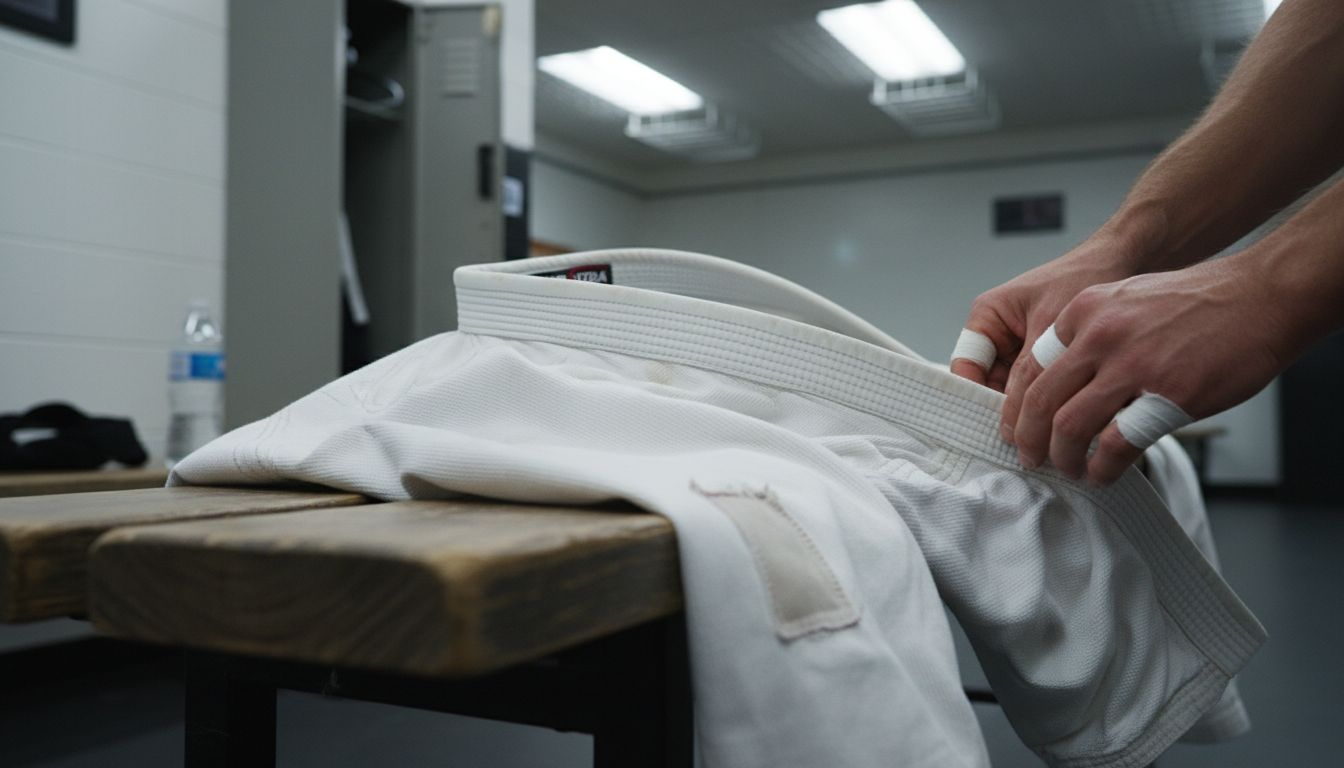
Custom sizing or cut options may suit some wearers, but fit and comfort depend on the exact measurement process, pattern and garment. Test a sample before a bulk order.
Fit advantages include:
- Check sleeve, trouser and torso measurements against the supplier's current size chart.
- Confirm any offered women's, youth, slim or other cut options before ordering.
- Assess fit on the wearer rather than assuming custom branding includes made-to-measure construction.
- Follow the exact garment's shrinkage and care guidance.
Compare the quoted cost, construction details, care instructions, warranty and expected use before deciding whether a custom gi program offers value.
Proper care extends custom gi longevity regardless of fabric quality. Academy owners should educate students on cold water washing, air drying instead of machine drying, immediate post-training washing to prevent bacteria buildup, proper storage to avoid mildew, and regular inspection of seams and patches for early repair opportunities.
Fit and construction are practical buying considerations. Use the custom gi guide to compare sizing and personalisation, then assess a sample for comfort and movement. Custom branding alone does not establish a competition-performance benefit.
Pro Tip: Implement a gi inspection program during promotions where instructors check uniform condition and provide care guidance. This maintains professional appearance standards while extending gi lifespan through proactive maintenance education.
Common misconceptions about custom BJJ gis
Academies can assess a custom-gi program through supplier quotes, a sample or pilot, member interest and full program cost.
Custom gis can support branding and merchandise goals. Evaluate them with student interest, supplier quotes, sell-through and full program cost rather than a general percentage claim.
Any uniform policy should state its purpose, costs, alternatives and the supplier terms clearly. Assess member feedback and applicable consumer obligations rather than assuming safety, identity or acceptance outcomes.
Key misconceptions to address:
- Cost: Compare like-for-like quotes and the academy's full program cost.
- Fit: Compare actual cuts and samples; branding alone does not establish better fit.
- Competition: Check the current organiser rules and the final garment.
- Demand: Use student feedback or pre-orders before committing to stock.
Academy-branded gis can provide a consistent visual identity. Measure reach, enquiries, enrolments and program cost before assigning an advertising value or retention effect to the clothing.
Transparency about custom gi programs builds trust with students and families. Clearly communicate pricing structures, explain how revenues support academy operations, offer payment plans for families facing financial constraints, and provide alternative uniform options when appropriate. Academies positioning custom gis as program investments rather than mandatory purchases face significantly less resistance while achieving similar adoption rates.
Ordering process and choosing the right manufacturer
Successfully implementing a custom gi program requires careful manufacturer selection and systematic ordering processes. Following proven steps ensures quality outcomes and smooth rollouts.
Key criteria for manufacturer selection:
- Relevant BJJ garment examples and sample availability.
- Clear fabric, sizing, artwork and care information.
- An itemised quote covering setup, revisions and shipping.
- A written production estimate and approval process.
- A willingness to review the exact competition requirements with you.
- Clear communication, sample approval and order terms.
Ordering timelines vary by supplier, quantity, specification, proofing, production location and shipping method. Obtain a written schedule with approval points and contingency time.
Step-by-step ordering process:
- Assess academy goals, budget constraints, and quantity requirements based on student population
- Research and contact 3 to 5 manufacturers requesting quotes and portfolio samples
- Evaluate proposals comparing pricing, timelines, customization options, and references
- Select manufacturer and finalize design through collaborative mockup process
- Review and approve physical samples, testing fit, fabric quality, and embroidery precision
- Review the supplier’s written payment schedule and payment protection before placing a bulk order
- Monitor production milestones through manufacturer updates and progress photos
- Coordinate delivery logistics and inspect shipment upon arrival
- Distribute gis to students with care instructions and sizing guidance
- Gather feedback for future orders and maintain manufacturer relationship
For a competition gi, check the current organiser and division rules before approving artwork or production. Confirm the exact garment, colours, patches and other uniform details against the current rule source.
Scaling tips for growing academies include starting with small pilot orders (15 to 25 units) to test manufacturer quality and student reception, implementing pre-order systems where students commit before production begins, establishing annual ordering cycles that leverage volume discounts, and maintaining inventory buffers for new student enrollments and unexpected demand.
Pro Tip: Build relationships with manufacturers by providing testimonials and social media features in exchange for priority service and preferential pricing on future orders. Long-term partnerships yield better outcomes than constantly switching suppliers. Explore resources on personalizing BJJ gi design and use tools to design your own BJJ gi for visual planning before manufacturer consultations.
Conclusion: making the decision for your academy
Custom BJJ gis may support academy branding and merchandise goals. Decide with supplier quotes, a pre-order or pilot, verified sell-through and student feedback.
Evaluating whether custom gis suit your academy requires honest assessment of current goals, student population size, budget flexibility, and competitive positioning. Small academies benefit from differentiation in crowded markets, while larger programs leverage economies of scale for maximum profit margins. Both scenarios present viable paths to positive returns when implemented thoughtfully.
Simple next steps to launch your custom gi program:
- Survey students and parents gauging interest and preferred pricing structures
- Research 3 to 5 manufacturers requesting quotes and portfolio samples
- Create initial design concepts incorporating academy logos and colors
- Start with pilot orders testing quality and student reception
- Establish clear policies and communication around uniform expectations
- Monitor results tracking retention, revenue, and student satisfaction metrics
Pro Tip: Prioritize IBJJF compliance and fabric quality over design complexity in your first custom gi order. Establishing reliable manufacturer partnerships and proving program viability matters more than perfect aesthetics initially. Refinements come naturally in subsequent orders once the foundation is solid.
Enhance your academy with custom gear from Combatra
Combatra lists custom BJJ gi options for academy branding. Check the exact product or quote for available fabric, embroidery, sizing, artwork, care and production details.
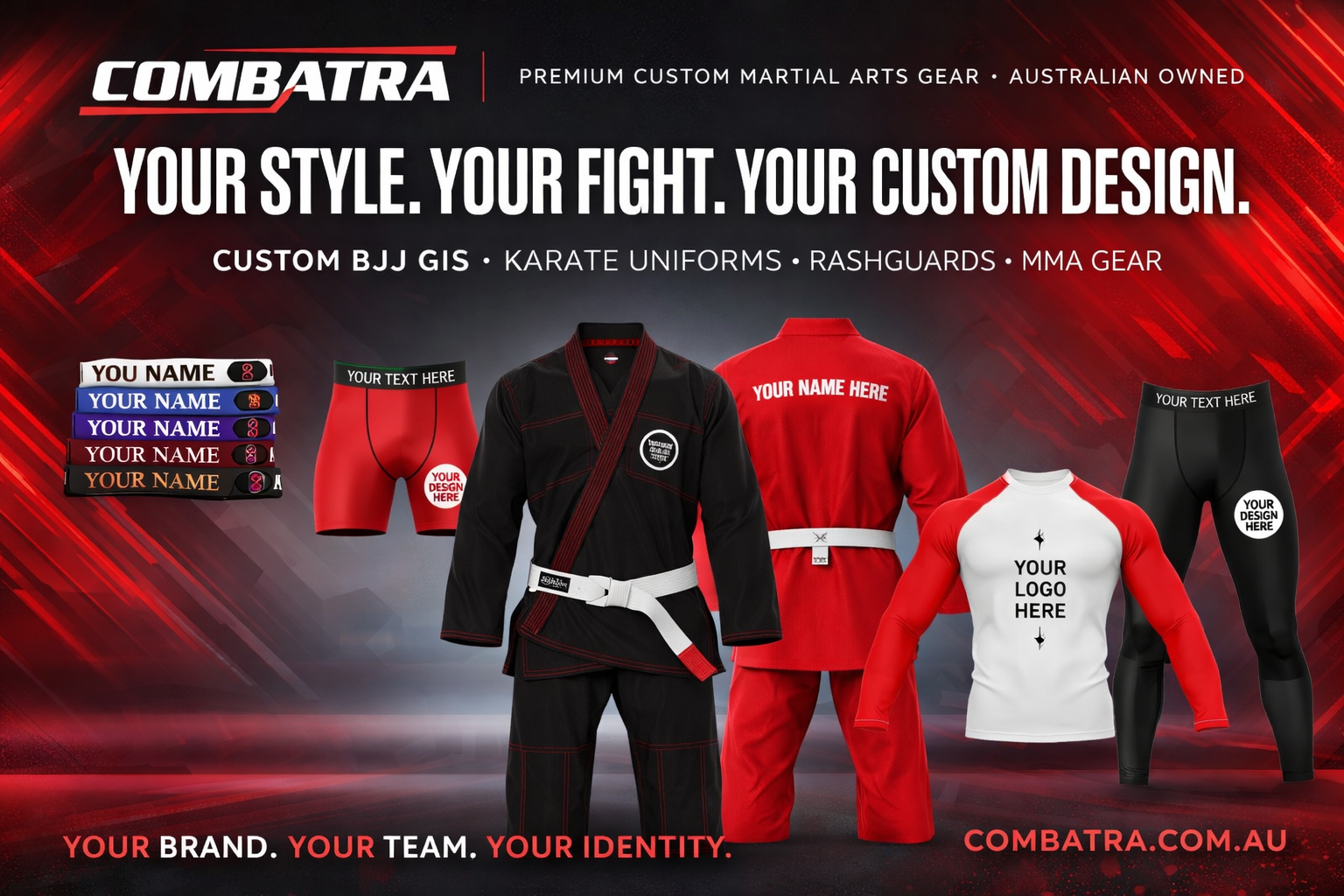
Explore Combatra's custom BJJ gi and personalisation options, then confirm artwork, sizing, fabric and production terms for the exact product or quote. Check your organiser's current rules before ordering a gi for competition.
FAQ
Is it difficult to ensure IBJJF compliance with custom gis?
Check the organiser's current rules for the exact competition and division, then confirm the garment and artwork against those requirements before production.
Can custom gis really improve student retention at my academy?
Matching academy colours may support team identity, but any retention effect must be measured in your own cohorts and checked against other changes.
What is the typical lead time for a custom gi order?
Lead time depends on the supplier, order, artwork approval, production location and shipping. Obtain a current written production and delivery estimate before setting a launch or competition date.
Are custom gis more expensive than standard gis?
Compare written quotes for like-for-like specifications. Long-term value depends on actual fit, sell-through, useful life, replacement rate and total landed cost.