


TL;DR:
- Choosing between MMA shorts and Muay Thai shorts depends on your primary training discipline, affecting mobility and fit. MMA shorts are longer with deep side slits and secure velcro waistbands, suited for grappling and ground work, while Muay Thai shorts are shorter with wide leg openings for high kicks and knee strikes. Custom shorts are valuable for fighters needing better fit, durability, or team branding, especially with frequent training or unique body proportions.
Choosing between MMA shorts and Muay Thai shorts is the most practical gear decision a fighter makes. Each style is engineered for a specific set of movements, and wearing the wrong cut in the wrong discipline costs you mobility when it matters most. MMA shorts use four-way stretch fabrics with reinforced seams and deep side slits to handle grappling, takedowns, and ground work. Muay Thai shorts prioritise wider leg openings and shorter hems for unrestricted high kicks and knee strikes. Australian fighters training outdoors also need to consider fabric breathability and sun protection, particularly during summer sessions where UV exposure is significant. Premium fight shorts tested to AS 4399:2020 and rated UPF 50+ add a layer of protection that standard gear simply does not offer. Understanding the difference between these two styles helps you train smarter and compete with confidence.
1. How do MMA shorts and Muay Thai shorts differ in design and cut?
The most visible difference between MMA and Muay Thai shorts is the cut. Muay Thai shorts are shorter with wider leg openings, designed specifically to allow unrestricted high kicks and knee strikes without fabric pulling against the thigh. MMA shorts run longer, typically sitting just above or at the knee, with deep side slits of 5–10cm to accommodate the hip extension needed for sprawls and guard work.
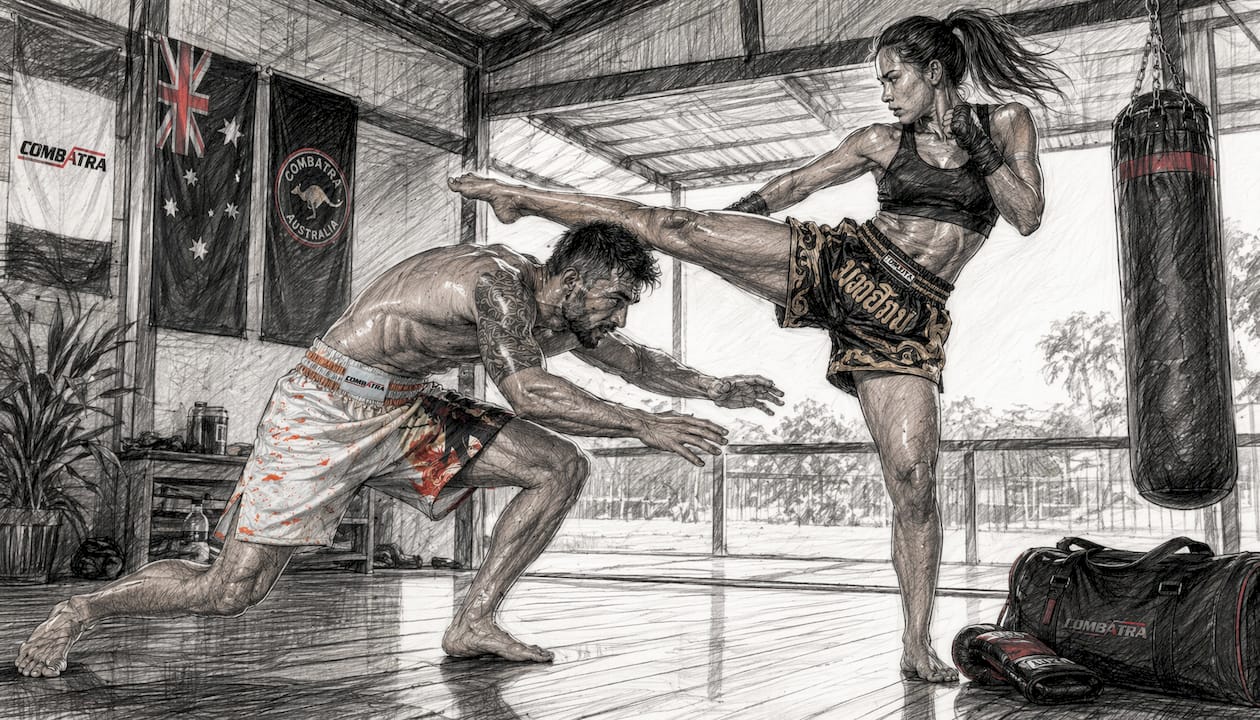
Waistband design also separates the two styles. MMA shorts commonly feature a velcro closure combined with an elastic or drawstring waistband. This dual system keeps the shorts locked in place during clinch work and takedowns. Muay Thai shorts rely on an elasticised or drawstring waistband alone, which is lighter and more comfortable for pure striking but offers less security during grappling exchanges.
The leg opening shape matters more than most fighters realise. Muay Thai shorts often lack side slits entirely because the wide cut already provides the necessary range of motion for lateral leg lifts and extreme hip flexion. MMA shorts compensate for their longer length with those deeper slits and a diamond gusset at the crotch.
- Muay Thai shorts: Short hem, wide leg opening, elastic or drawstring waistband, minimal or no side slits
- MMA shorts: Longer cut, deep side slits (5–10cm), velcro and elastic waistband, reinforced seams
- Key rule: If your training involves any grappling, the longer MMA cut with a secure waistband protects you better
Pro Tip: Before buying, do a slow-motion high kick and a sprawl in the fitting room. If the shorts pull or ride up in either movement, the cut is wrong for your training.
2. What fabrics and materials best suit each style?
Fabric choice defines how a pair of shorts performs under real training conditions. MMA shorts commonly use 96% polyester and 4% spandex blends to balance durability with elasticity. That small percentage of spandex delivers the four-way stretch needed for ground movements without the fabric losing its shape over time.
Muay Thai shorts favour lighter, breathable polyester or satin-like fabrics. The priority is airflow and freedom of movement rather than abrasion resistance. Satin-weave polyester feels smooth against the skin and dries quickly, which suits the high-output, sweat-heavy nature of Muay Thai training in Australia’s warm climate.
Ripstop polyester is the standard outer-shell fabric for durable MMA shorts. Its grid-reinforced weave limits tearing under grappling stress, and ripstop fabrics typically weigh between 150–220 GSM, balancing lightness with abrasion resistance. That weight range keeps the shorts light enough for striking while tough enough to survive mat work.
Compression-lined MMA shorts add another layer of benefit. Compression knit fabrics stretch up to 150% and provide graduated muscle support that reduces muscle oscillation during training. This supports faster recovery between rounds and across heavy training weeks.
| Feature | MMA shorts | Muay Thai shorts |
|---|---|---|
| Primary fabric | Polyester-spandex blend (96/4) | Lightweight polyester or satin |
| Outer shell option | Ripstop polyester (150–220 GSM) | Standard woven polyester |
| Stretch type | Four-way stretch | Two-way or natural drape |
| Compression lining | Common | Rare |
| Abrasion resistance | High | Moderate |
| Breathability | Moderate to high | High |
Pro Tip: In Australian summer training, prioritise moisture-wicking polyester over satin-style fabrics for Muay Thai. Satin looks great but holds sweat against the skin in humid conditions.
3. How mobility and performance demands shape your choice
Mobility requirements differ sharply between the two disciplines. Muay Thai demands extreme hip flexion for teep kicks, lateral leg extension for roundhouse kicks, and rapid knee-strike repetitions. Muay Thai shorts’ wide leg openings reduce restriction during these movements without relying on slits or gussets. The shorter hem keeps fabric away from the knee entirely.
MMA requires a broader range of movements across multiple planes. A fighter needs to throw head kicks, shoot double-leg takedowns, work from guard on the ground, and scramble back to their feet, all within a single round. Side slits combined with diamond gussets allow high degrees of lateral and vertical leg extension without the shorts riding up during transitions.
The trade-off is real. Muay Thai shorts give you maximum freedom for striking but can shift or bunch during clinch work and ground exchanges. MMA shorts stay put under grappling pressure but feel slightly more restrictive during pure kicking drills until the fabric breaks in.
Key mobility features to check before buying:
- Side slit depth: Deeper slits (7–10cm) suit fighters who kick frequently in MMA training
- Gusset construction: A diamond gusset at the crotch prevents seam failure during sprawls and guard passes
- Waistband security: A velcro closure stops the shorts from shifting during takedowns
- Fabric stretch: Four-way stretch reduces the need for very deep slits by providing equivalent mobility with a cleaner fit
4. When do custom MMA shorts make sense for Australian fighters?
Custom MMA shorts make sense when off-the-shelf sizing does not match your body proportions or when your training volume demands a more durable build. Fighters with longer legs relative to their waist, or those who train six or more sessions per week, benefit most from a personalised cut.
Sublimation printing on custom shorts allows gym logos, fighter names, and sponsor graphics without affecting fabric stretch or durability. The ink bonds directly to the polyester fibres rather than sitting on top, so the design does not crack or peel under repeated washing and mat friction. This makes custom gear practical, not just cosmetic.
Custom options also let you specify reinforced stitching at high-stress points, choose your preferred side-slit depth, and select a waistband system that suits your body. These details matter at competition level, where a waistband that shifts during a clinch or a seam that tears mid-round creates a real performance problem.
- Assess your training volume. Fighters training more than four sessions per week wear through standard shorts faster. Custom construction with reinforced seams extends the lifespan significantly.
- Identify your fit gaps. If standard sizing consistently leaves you with excess fabric at the waist or insufficient length in the leg, a custom cut solves both problems at once.
- Consider team or gym orders. Combatra’s custom sportswear programme suits academies ordering matching gear for their team, with consistent branding across every pair.
- Budget realistically. Custom shorts cost more upfront but typically outlast two or three pairs of budget off-the-shelf options.
Pro Tip: Order a sample pair before committing to a full team order. Even small adjustments to slit depth or waistband width make a noticeable difference once you are on the mat.
5. What design styles and aesthetics set these shorts apart?
Design language in fight shorts is not purely cosmetic. It reflects the cultural roots of each discipline and shapes how a fighter presents themselves in the gym and at competition.
Muay Thai shorts feature bold colours and traditional Thai script with symbolic designs drawn from Thai cultural heritage. Bright reds, golds, and blues with ornate patterns are standard. This aesthetic signals striking arts identity and carries real cultural weight for fighters who train in the Thai tradition. Combatra’s Samurai Warrior Muay Thai Shorts and Combat Armor Muay Thai Shorts bring bold design together with performance fabric, making them a strong choice for fighters who want both.
MMA shorts trend towards geometric patterns, solid colours, or subtle graphics suited to multi-discipline training. The restrained aesthetic works across striking and grappling sessions without looking out of place in either context. For fighters who cross-train across BJJ, wrestling, and Muay Thai, a clean MMA short is the more versatile visual choice.
Design considerations worth weighing:
- Gym rules: Some academies require specific colours or prohibit logos. Check before ordering.
- Competition rules: Certain promotions have strict guidelines on short length and waistband style.
- Personal identity: A fighter who competes primarily in Muay Thai benefits from wearing shorts that reflect that discipline’s tradition.
- Versatility: Fighters who cross-train benefit from a neutral MMA design that works across multiple sessions without standing out for the wrong reasons.
The Golden Black Muay Thai Shorts from Combatra offer a strong middle ground, pairing a striking aesthetic with a functional cut that suits both dedicated Muay Thai sessions and general striking training.
Key takeaways
The right choice between MMA shorts and Muay Thai shorts depends entirely on your primary training discipline, with cut, fabric, and waistband design each playing a direct role in your mobility and performance.
| Point | Details |
|---|---|
| Cut determines discipline fit | Muay Thai shorts suit pure striking; MMA shorts suit mixed grappling and striking training. |
| Fabric affects durability and comfort | Ripstop polyester-spandex blends handle grappling stress; satin-style fabrics suit striking sessions. |
| Waistband security matters in grappling | Velcro-plus-elastic systems in MMA shorts prevent shifting during takedowns and clinch work. |
| Custom shorts solve fit and durability gaps | Personalised cut, reinforced seams, and sublimation printing extend performance and lifespan. |
| Design reflects discipline identity | Muay Thai shorts carry cultural significance; MMA shorts offer multi-discipline versatility. |
What I have learned from years on the mat
The debate about MMA shorts vs Muay Thai shorts gets overcomplicated. Fighters spend hours reading about fabric weights and slit depths when the real answer is simpler: wear what your primary discipline demands, and do not compromise on waistband security.
I have seen grapplers train in Muay Thai shorts and spend half the session pulling fabric out of awkward positions. I have also seen pure strikers wear long MMA shorts and lose half a centimetre of kick extension because the hem catches at the wrong moment. Neither situation is catastrophic, but both are avoidable.
The insight most articles miss is this: the waistband is the most important feature in MMA shorts, not the fabric. A velcro closure that fails mid-round is a distraction and a safety issue. Fighters who train hard enough to consider custom gear should prioritise waistband construction above everything else.
For Australian fighters training outdoors during summer, fabric breathability is not a secondary concern. It is a primary one. A satin-style Muay Thai short that traps sweat in 35-degree heat will affect your performance more than a slightly suboptimal slit depth. Pair your fight shorts with a quality compression short underneath for added muscle support and moisture management in those conditions.
My honest advice: buy one pair of dedicated Muay Thai shorts and one pair of MMA shorts. Train in each for a month. Your body will tell you which cut suits your movement patterns better than any guide can.
— McGinnis
Combatra’s fight shorts for Australian martial artists
Combatra builds fight shorts for fighters who train hard and need gear that keeps up. Whether you are looking for Muay Thai shorts with bold designs and striking-focused cuts, or MMA shorts engineered for four-way stretch and grappling durability, the range covers both disciplines with performance fabrics and reinforced construction.
The Combatra custom sportswear programme lets you personalise your shorts with gym branding, fighter names, and specific design features, all without compromising fabric stretch or seam integrity. For fighters who want full training kit, Combatra’s fitness accessories partners round out your gear setup. Shop the full range and find the cut that matches your training.
FAQ
What is the main difference between MMA and Muay Thai shorts?
MMA shorts are longer with deep side slits, reinforced seams, and a velcro-elastic waistband for grappling security. Muay Thai shorts are shorter with wider leg openings and a lighter waistband designed for unrestricted kicking.
Can I wear Muay Thai shorts for MMA training?
You can, but the shorter cut and lighter waistband offer less security during takedowns and ground work. MMA-specific shorts with a velcro closure and gusset construction perform better across the full range of MMA movements.
What fabric is best for MMA shorts?
A 96% polyester and 4% spandex blend delivers the best balance of durability and four-way stretch for MMA training. Ripstop polyester outer shells add abrasion resistance for mat work.
Are custom MMA shorts worth the cost for amateur fighters?
Custom shorts make sense for fighters training four or more sessions per week, or those who cannot find a good off-the-shelf fit. Reinforced seams and a personalised cut extend the lifespan and improve comfort over standard options.
What should I wear for Muay Thai training in Australia?
Wear traditional Muay Thai shorts with a wide leg opening and breathable polyester or satin-style fabric. In hot Australian conditions, prioritise moisture-wicking polyester over satin to manage sweat during high-output sessions.