


TL;DR:
- A rashguard is a high-stretch garment made from synthetic fibers designed for compression, abrasion resistance, and quick drying. Proper fabric choice, knit construction, and lab certification for UPF 50+ ensure optimal performance and sun protection, especially in Australia’s high UV environment. Choosing the right size, fiber blend, and seam construction extends durability and maintains UV and compression benefits.
A rashguard is a high-stretch synthetic garment made from a polyester- or nylon-based fabric blended with elastane, engineered to deliver compression, abrasion resistance and quick drying. The fabric choice determines almost everything about how the garment performs: how tightly it compresses, how fast it dries, how long it lasts on the mat, and whether it provides reliable sun protection during outdoor training.
The quick verdict by use-case:
- Grappling (BJJ/MMA): Choose a nylon-rich blend with elastane to ensure superior abrasion resistance and a smooth, skin-friendly feel.
- Sublimation-printed or team gear: Polyester-spandex blends hold colour better, dry faster and cost less to produce.
- Outdoor and summer training: Prioritise UPF 50+ rated gear with lab certification under AS 4399:2020.
Pro Tip: Size correctly. A rashguard stretched beyond its design range loses UPF performance because the fabric weave opens up under tension, letting more UV through.
Rashguards were originally developed for surfing to prevent board rash, but compression rash guards built for BJJ and MMA are a different animal. They sit closer to the body, use heavier compression knits, and face far more mechanical stress than a surf top ever does. For Australian athletes, the stakes are higher still: training outdoors or in summer conditions means UV exposure is a genuine health concern, not an afterthought. Australia has one of the highest rates of skin cancer in the world, and UPF-rated clothing is one of the most effective barriers available.
Premium compression rashguards can be lab tested under AS 4399:2020, the Australian and New Zealand standard for sun-protective clothing, and rated UPF 50+ to confirm they block at least 98% of solar ultraviolet radiation. That certification matters because not all UPF claims on product pages are backed by independent testing. Combatra approaches rashguard design from a performance-first position: fabric selection, GSM targets, elastane percentages and seam construction are all evaluated against real training demands before a product reaches an athlete’s kit bag. The sections below break down exactly what goes into that process.
Table of Contents
- What are the core fibres in rashguard material?
- How knit construction changes the way your rashguard performs
- How blend ratios and elastane percentage affect your rashguard
- Sun protection and UPF for rashguards in Australia
- Which fabrics and constructions resist grappling wear?
- How to wash and care for compression rashguards
- How to choose the right compression rashguard for your training
- How Combatra selects and tests rashguard materials
- Key takeaways
- The trade-offs most athletes get wrong
- Combatra compression rashguards: tested for the mat and the sun
- Useful sources and further reading
What are the core fibres in rashguard material?
Three fibres do most of the work in any compression rashguard: polyester, nylon (polyamide) and elastane (also sold as spandex or Lycra). Understanding what each one contributes makes it much easier to read a fabric label and know what you are actually buying.
Polyester is hydrophobic, meaning it repels water rather than absorbing it. That property makes it highly effective for wicking sweat away from the skin and drying quickly between rounds. It also accepts sublimation ink better than nylon, which is why most brightly printed team rashguards use a polyester-spandex base. The trade-off is a slightly stiffer hand-feel and marginally lower abrasion resistance compared to nylon.
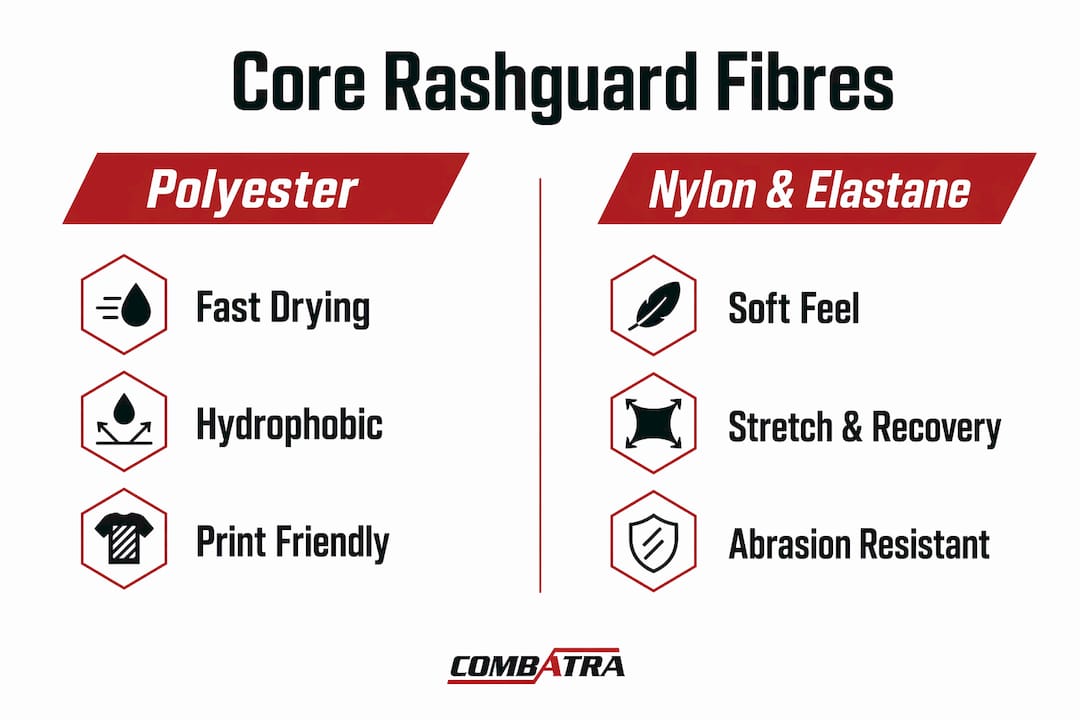
Nylon (polyamide) offers a noticeably softer feel against the skin and stronger abrasion resistance, making it the preferred choice for grappling-focused rashguards. When you are drilling takedowns, guard passing and scrambles on a rough mat surface, nylon holds up longer. It absorbs slightly more moisture than polyester but still dries quickly in a compression knit construction.
Elastane (spandex/Lycra) is the stretch component. On its own it has no structural role, but blended at 15–25% it gives the fabric four-way stretch, compression recovery and the ability to return to its original shape after repeated loading. Higher elastane percentages produce a firmer compression feel; lower percentages give a lighter, more breathable result.
| Fibre | Strength | Weakness | Best for |
|---|---|---|---|
| Polyester | Fast drying, print-ready | Slightly stiffer feel | Sublimation-printed, sweat-heavy training |
| Nylon | Soft hand-feel, abrasion resistant | Slightly slower drying | Grappling, mat-intensive BJJ/MMA |
| Elastane | Four-way stretch, compression recovery | Reduces UPF when over-stretched | Blended into all rashguards at 15–25% |
Pro Tip: Check the fibre label before you buy. A rashguard labelled simply “polyester/spandex” with no GSM or elastane percentage listed is giving you the minimum information. Reputable manufacturers publish full fabric specs.
How knit construction changes the way your rashguard performs
The fibre blend is only half the story. How those fibres are knitted together determines compression behaviour, breathability, stretch direction and how the garment holds up under friction.
Single jersey is the lightest construction: one layer of interlocked loops, typically 150–180 GSM. It stretches easily in multiple directions and breathes well, but offers less compression and lower abrasion resistance. You will find it in lighter surf rashguards and training tops designed for warm-weather comfort.
Interlock knit uses two interlocked jersey layers, producing a denser, smoother fabric on both faces. It sits in the 180–220 GSM range, delivers more even compression and resists pilling better than single jersey. Many mid-weight BJJ rashguards use interlock construction.
Compression knits and warp-knit fabrics are the heaviest performers, typically 220–280 GSM. Warp-knit construction locks yarns in a diagonal pattern that resists distortion under load, which is why it is used in medical-grade compression garments and high-performance athletic wear. Tighter constructions and higher GSM increase abrasion resistance and UPF, while looser knits improve breathability but reduce protection.
Microfibre yarns (finer denier threads) produce a softer surface and improve moisture-wicking speed because the increased surface area draws sweat away faster. Coarser yarns are more durable but feel rougher against skin, which matters when a training partner’s grip is dragging across your shoulder for an hour.
Key construction trade-off: A heavier GSM compression knit gives you better abrasion resistance and UPF, but it retains slightly more heat. A lighter jersey knit breathes better but wears faster on rough mats. For Australian summer training, a mid-weight compression knit (around 200–230 GSM) in a nylon-spandex blend tends to balance both demands well.
Construction trade-offs at a glance:
- Higher GSM = more abrasion resistance, higher UPF, more compression
- Lower GSM = better breathability, lighter feel, faster drying
- Warp-knit = superior stretch recovery and shape retention
- Single jersey = maximum airflow, minimal compression
- Microfibre yarn = softer feel, faster wicking, slightly less durable than coarser yarn
How blend ratios and elastane percentage affect your rashguard
The specific percentages on a fabric label are not just marketing numbers. They directly affect how a rashguard compresses, breathes, prints and holds up over time.
For BJJ and MMA, the industry standard uses a nylon blend with a significant proportion of elastane. That ratio delivers strong compression recovery, a smooth surface that resists mat abrasion, and enough stretch for full-range grappling movement. For sublimation-printed rashguards, the standard shifts to an 85–90% polyester base with 10–15% elastane, which gives the ink something to bond with permanently and keeps colours vivid through hundreds of washes.
How elastane percentage changes performance:
- 10–15% elastane: lighter compression, more breathable, better for warm-weather outdoor use
- 18–22% elastane: firm compression, strong recovery, standard for BJJ/MMA
- Above 22% elastane: very firm compression, slower to dry, can reduce UPF when stretched
Higher elastane content increases compression and recovery, but stretching fabric reduces its UPF because the weave opens up and allows more UV through. This is why sizing correctly is not just a comfort issue for outdoor athletes.
Choosing your blend by priority:
- Abrasion resistance first: 78–82% nylon + 18–22% elastane, 220+ GSM
- Print vibrancy first: 85–90% polyester + 10–15% elastane, sublimation-ready
- Moisture management first: polyester-dominant blend, lower GSM, single jersey or interlock
- UPF reliability first: tighter compression knit, correct sizing, lab-certified UPF 50+
A practical label check: if a rashguard lists 90% polyester and 10% elastane with no GSM figure, it is likely a lightweight print-focused garment, not a compression-grade grappling top. Both have their place, but they are not interchangeable.
Sun protection and UPF for rashguards in Australia
Australia’s UV environment is not comparable to most other countries. UPF-rated clothing is one of the most reliable forms of sun protection available, and for athletes training outdoors, a lab-tested rashguard is a practical first line of defence.
UPF 50+ blocks at least 98% of solar ultraviolet radiation, according to AS 4399:2020, the Australian and New Zealand standard for sun-protective clothing. UPF 30 blocks 96.7%; UPF 15 blocks 93.35%. The gap between UPF 30 and UPF 50+ is meaningful for all-day outdoor exposure.
The standard classifies UPF ratings into three protection levels: good (UPF 15–24), very good (UPF 25–39) and excellent (UPF 40–50+). Only garments rated UPF 40 or above are suitable for all-day outdoor use by people with fair skin.
What reduces UPF in practice:
- Stretching the fabric beyond its design range opens the weave and lets more UV through
- Wet fabric can reduce protection, particularly in lighter knits
- Faded or worn fabric loses some of its protective density over time
- Lighter colours generally provide lower UPF than darker or denser weaves
Checklist for verifying UPF claims when buying:
- Look for explicit reference to AS 4399:2020 (or AS/NZS 4399:2020) on the product page or label
- Check whether the brand references independent lab testing, not just a self-declared rating
- Confirm the UPF 50+ label appears on the garment itself, not just in marketing copy
- Read sizing guidance: a rashguard sized too small will be over-stretched and lose UPF performance
- For custom or printed rashguards, lab-tested UPF certification is the only reliable way to confirm that printing has not reduced protection
Australian athletes should treat any UPF claim without an AS 4399:2020 reference as unverified. Custom printing and stretch can both materially reduce protection, and independent lab testing is the only way to confirm the final garment still meets the rated standard.
Which fabrics and constructions resist grappling wear?
Durability in a compression rashguard is not just about the fibre type. It is the combination of fibre, GSM, knit construction and seam choice that determines how long a garment survives regular mat work.
Nylon-dominant blends hold up better under mat abrasion than polyester equivalents. The fibre itself is tougher, and the smoother surface reduces friction points during clinch work, guard passing and takedown drilling. Pairing a nylon-spandex blend with a higher GSM (220+ for grappling) gives the fabric more material to absorb friction before it starts to thin.
High-wear zones to check on any rashguard:
- Underarm and shoulder panels (constant friction during clinch and guard work)
- Collar and neckline (repeated grip and pull stress)
- Side seams (lateral stretch and compression during ground work)
- Cuffs (rolling and gripping contact)
Seam construction matters as much as fabric choice. Flatlock seams sit flat against the skin with no raised ridge, which eliminates the friction point that standard overlocked seams create under mat pressure. Bonded seams go further by removing the seam thread entirely and fusing panels with adhesive, producing the smoothest possible surface. Both options significantly reduce skin irritation during long grappling sessions.
For comparison, surfers and outdoor athletes face UV and saltwater degradation rather than mechanical abrasion. A lighter polyester rashguard that would wear through quickly on a BJJ mat can last years in a surf context. The cross-training demands of surfers who also train on the mat are a good example of why fabric choice needs to match the primary use-case.
Pro Tip: When evaluating a rashguard for grappling, turn it inside out and run your thumb along the seams. A flatlock seam feels nearly flush with the fabric. A raised overlocked seam is a friction point waiting to cause irritation during a two-hour session.
How to wash and care for compression rashguards
Proper care extends the life of the compression fabric, preserves sublimation prints and maintains UPF performance. The elastane component is the most vulnerable part of any rashguard, and most premature failures come from heat damage or chemical degradation rather than physical wear.
- Rinse immediately after training. Salt, sweat and chlorine degrade elastane fibres quickly. A cold-water rinse within an hour of training removes the worst of it before it sets.
- Wash in cold water (30°C maximum). Hot water breaks down elastane and causes compression fabrics to lose recovery. Use a gentle or delicate cycle.
- Use a mild, pH-neutral detergent. Avoid bleach entirely. Fabric softener coats the fibres and reduces moisture-wicking performance over time.
- Turn the garment inside out before washing. This protects the sublimation print surface and reduces friction against other garments in the machine.
- Air dry flat or on a hanger away from direct sunlight. Tumble drying, even on a low setting, degrades elastane faster than any other care mistake. Direct sunlight bleaches prints and weakens fibres.
- For odour and bacteria, soak in a gentle textile-safe sanitiser (such as a diluted white vinegar solution or a sport-wash product) for 20–30 minutes before washing. Avoid antibacterial soaps with harsh surfactants.
- Store flat or loosely rolled, not compressed in a tight space. Storing a rashguard folded tightly under other gear for extended periods can set creases into the compression fabric.
When to retire a rashguard: visible thinning or fraying at high-wear zones, loss of compression recovery (the garment feels loose after washing), faded UPF labelling with no replacement certification, or pilling that has broken through the surface of the knit. A rashguard that no longer compresses properly is also no longer providing its rated UPF.
How to choose the right compression rashguard for your training
Matching fabric and construction to your primary use-case saves money and improves performance. The decision is simpler than it looks once you know what to prioritise.
Decision checklist:
- What is your primary sport? BJJ/MMA grappling, or outdoor/surf training?
- Do you need sublimation printing for team or academy branding?
- Will you train outdoors in Australian summer conditions?
- What is your compression preference: firm (higher elastane) or moderate?
- Do you run hot? Consider a lighter GSM and looser knit for breathability.
Step-by-step selection guide:
- Start with fibre type. Grappling athletes: choose nylon-spandex. Outdoor/surf athletes or those prioritising print: choose polyester-spandex.
- Check the elastane percentage. For BJJ/MMA, 18–22% elastane gives the right compression balance. For outdoor use, 10–15% elastane in a lighter knit breathes better.
- Confirm the GSM. For mat work, a medium to higher GSM fabric is recommended; outdoor training requires a lighter to medium weight fabric GSM.
- Verify UPF certification. If you train outdoors, look for AS 4399:2020 lab testing and a UPF 50+ label on the garment, not just on the product page.
- Check seam construction. Flatlock or bonded seams for grappling; standard seams are fine for outdoor or surf use.
- Size correctly. A rashguard should feel firm but not restrict breathing or movement. Over-sizing reduces compression; under-sizing over-stretches the fabric and reduces UPF.
Sizing and fit notes:
- Compression rashguards should feel snug across the chest and shoulders without pulling at the collar
- If the fabric is visibly white-lining (pale patches where it is over-stretched), size up
- For layering under a BJJ gi, size down one from your usual fit to avoid bunching
- Athletes considering full compression kits can pair a rashguard with compression spats for consistent fabric performance top to bottom
When sublimation printing is a requirement for team gear, polyester-spandex is the production standard. The ink bonds permanently to polyester fibres and survives repeated washing without cracking or peeling, which is why it is the default for academy team orders.
How Combatra selects and tests rashguard materials
Combatra’s fabric selection process starts with performance criteria, not cost. For each compression rashguard, the evaluation covers fibre type and blend ratio, GSM target, elastane percentage, knit construction and seam choice, all assessed against the demands of real BJJ and MMA training.
Fabric evaluation criteria:
- Fibre blend: nylon-spandex for grappling-focused garments; polyester-spandex for sublimation-printed designs
- GSM targets: 200–250 GSM for compression rashguards; lighter constructions for outdoor-specific gear
- Elastane percentage: 18–22% for firm compression recovery in grappling garments
- Seam construction: flatlock seams as standard on grappling rashguards to eliminate friction points at shoulder and underarm panels
- UPF testing: garments intended for outdoor use are tested under AS 4399:2020 to confirm UPF 50+ performance after printing and construction
Real-world testing includes compression recovery cycles (repeated stretch and release to confirm the fabric holds its shape), abrasion trials on mat-equivalent surfaces, and field testing in BJJ and MMA sessions. Athlete feedback on fit, compression feel and skin comfort after long sessions feeds back into fabric and construction decisions.
On UPF and custom printing: independent lab testing under AS 4399:2020 is the only reliable way to confirm that a sublimation-printed rashguard still meets UPF 50+ after the print process. Combatra references lab certification for UPF-rated garments rather than relying on self-declared ratings, because customisation and stretch can materially reduce protection from the base fabric’s original rating.
The Design Your Own BJJ Rashguard – UPF 50+ is an example of this process applied to a custom-build product: athletes and academy teams can personalise the design while the underlying fabric and construction meet the same performance and UPF standards as Combatra’s standard range. McGinnis oversees the design and testing process, with a focus on garments that perform under the specific conditions Australian athletes face.
Key takeaways
Rashguard material performance comes down to three things: the right fibre blend for your sport, the correct GSM and knit construction for your training intensity, and verified UPF 50+ certification if you train outdoors in Australian conditions.
| Point | Details |
|---|---|
| Choose fibre by sport | Nylon-spandex (78–82% nylon) for grappling; polyester-spandex for sublimation-printed or outdoor gear. |
| Elastane percentage matters | 18–22% elastane gives firm compression for BJJ/MMA; higher percentages reduce UPF when stretched. |
| Verify UPF claims | Look for AS 4399:2020 lab certification and a UPF 50+ label on the garment, not just on the product page. |
| Care preserves performance | Wash cold, air dry, avoid bleach and fabric softener to maintain compression recovery and UPF. |
| Combatra custom rashguards | The Design Your Own BJJ Rashguard offers lab-tested UPF 50+ with personalised design for individuals and teams. |
The trade-offs most athletes get wrong
Most buyers focus on price and aesthetics, then wonder why their rashguard bags out after three months or leaves them with mat burn after a hard session. The fabric science is not complicated, but it does require reading past the marketing copy.
The most common mistake is choosing a rashguard that is too small. Athletes assume a tighter fit means better compression, but over-stretching a compression fabric does two things: it accelerates elastane fatigue, and it opens the weave enough to reduce UPF performance. A rashguard that fits correctly should feel firm, not restrictive. If you are white-lining the fabric across the chest, you are already past the design stretch range.
The second mistake is treating all UPF 50+ labels as equivalent. A self-declared rating on a product page and a lab-certified result under AS 4399:2020 are not the same thing. Custom printing, stretch and garment construction all affect the final UPF of a finished garment, and only independent testing confirms the number holds. For academy owners ordering team gear, this distinction is worth asking about directly before placing a bulk order.
For grappling athletes specifically, the seam choice is underrated. Flatlock seams are not a luxury feature; they are a functional requirement for anyone training more than three sessions a week. The friction difference between a flatlock and an overlocked seam becomes very apparent after a two-hour session involving sustained clinch work.
Combatra compression rashguards: tested for the mat and the sun
Combatra builds compression rashguards for athletes who need both performance and protection. The garments use nylon-spandex or polyester-spandex blends selected for the specific demands of BJJ, MMA and outdoor training, with flatlock seam construction and UPF 50+ lab testing under AS 4399:2020 for outdoor-rated styles.
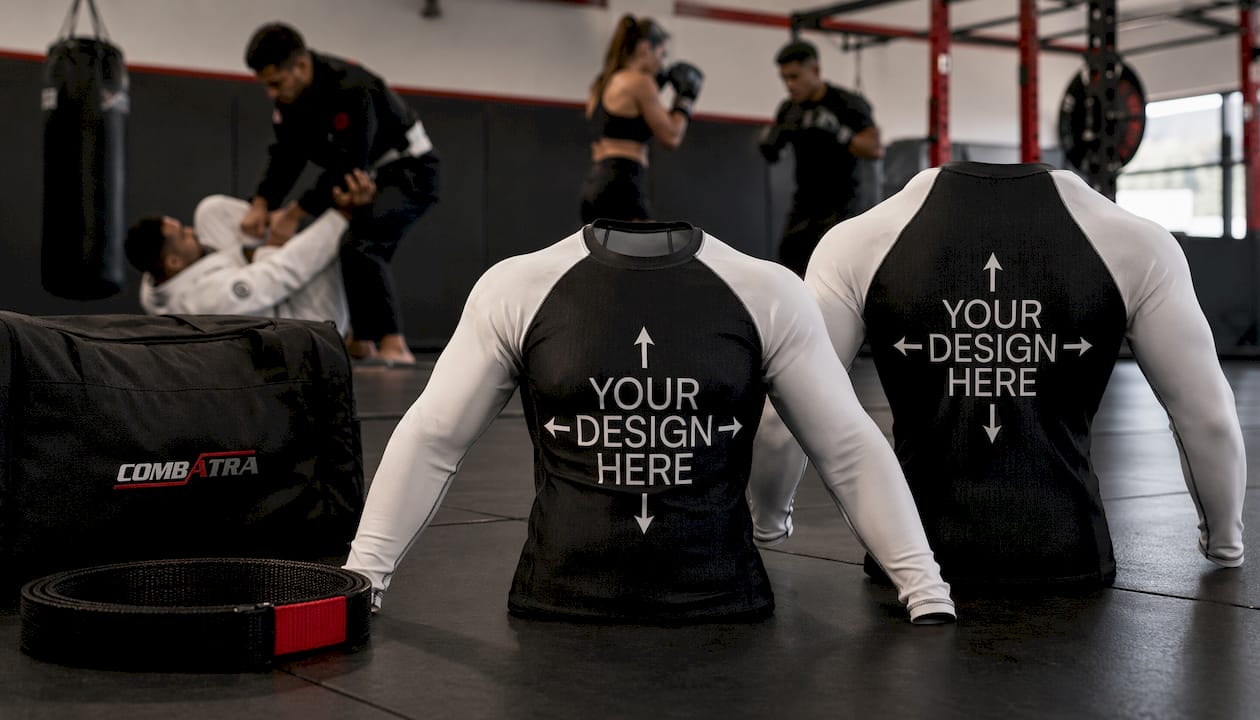
For athletes who want a personalised option, the Design Your Own BJJ Rashguard lets you configure colours, logos and names while keeping the same fabric and construction standards as the standard range. Academy teams can order matching gear without compromising on compression quality or UPF performance. Check the full range of compression rashguards and compare fabric specs and UPF labelling before you buy.
Useful sources and further reading
- ARPANSA: Australian sun-protective clothing standard (AS/NZS 4399:2020) — the primary Australian government source for UPF classification and labelling requirements
- Cancer Council Australia: sun-protective clothing — practical guidance on UPF ratings, how stretch and wetness affect protection, and what to look for on labels
- VISIONSafe: UPF ratings and the Australian sun-protective clothing standard — detailed explainer on AS 4399:2020, lab testing and why certification matters for custom garments
- Combatra: UPF 50+ clothing explained — Combatra’s guide to how athletic apparel provides certified UV protection under Australian standards
- Combatra: best rashguards for Australian summer training — buyer-focused guide with model recommendations for Australian summer conditions
- Combatra: rashguard selection guide for BJJ — practical selection tips and fit guidance specific to BJJ athletes