


TL;DR:
- Compression arm sleeves help regulate body temperature, improve blood flow, and protect muscles during outdoor training in cold weather. They can be quickly removed or adjusted, preventing overheating and reducing injury risk from muscle tremors and joint stiffness. Proper care extends their effective lifespan, making them a versatile and valuable choice for athletes training in variable Australian winter conditions.
Compression arm sleeves are specialised performance garments designed to regulate temperature, improve blood flow, and protect muscles during physical activity. For Australian athletes training outdoors in cooler months, they serve a dual purpose: keeping muscles warm enough to perform while managing sweat and preventing overheating mid-session. Premium sleeves, like those rated UPF 50+ and lab-tested to AS 4399:2020, also shield skin from UV exposure during outdoor training. Whether you train in BJJ, MMA, running, or cycling, the question of whether compression arm sleeves can help during cold weather training has a clear answer: yes, and the reasons go well beyond basic warmth.
Can compression arm sleeves help during cold weather training?
Compression arm sleeves act as lightweight thermal layers that trap body heat close to the skin, preventing muscle stiffness without causing overheating during intense effort. That distinction matters. A full thermal top locks you into one temperature setting for the entire session. Arm sleeves give you control.
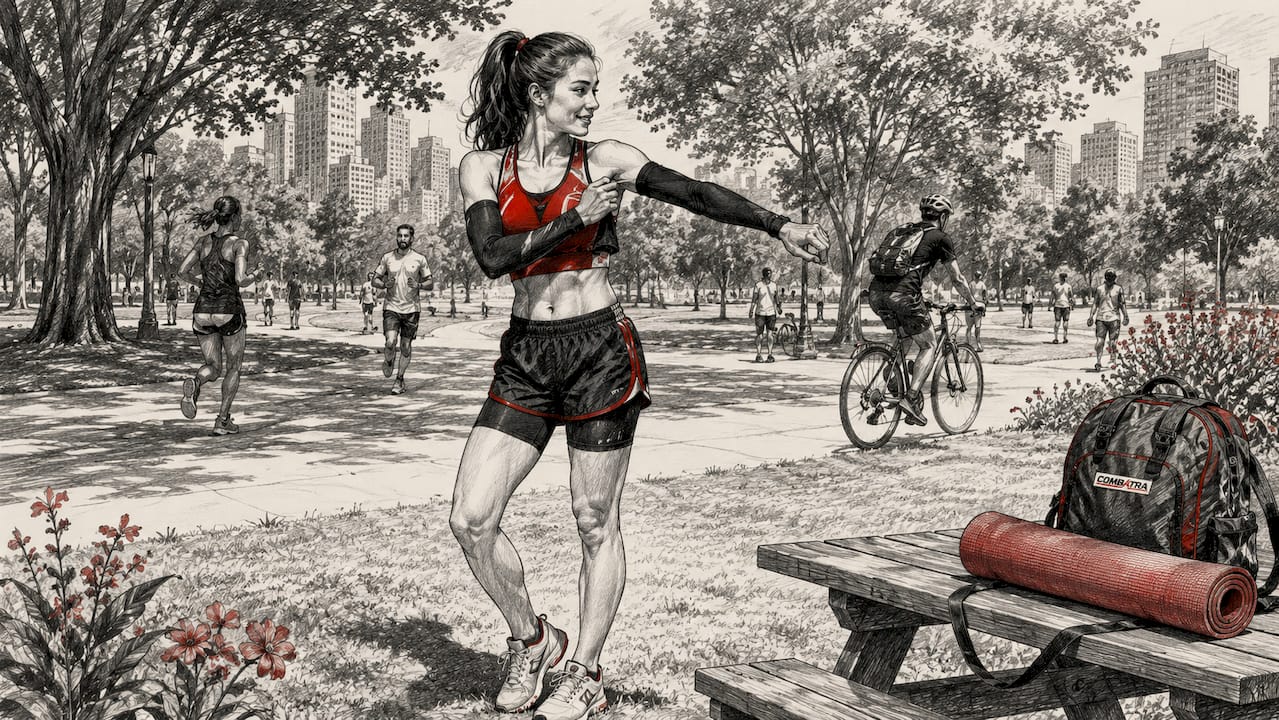
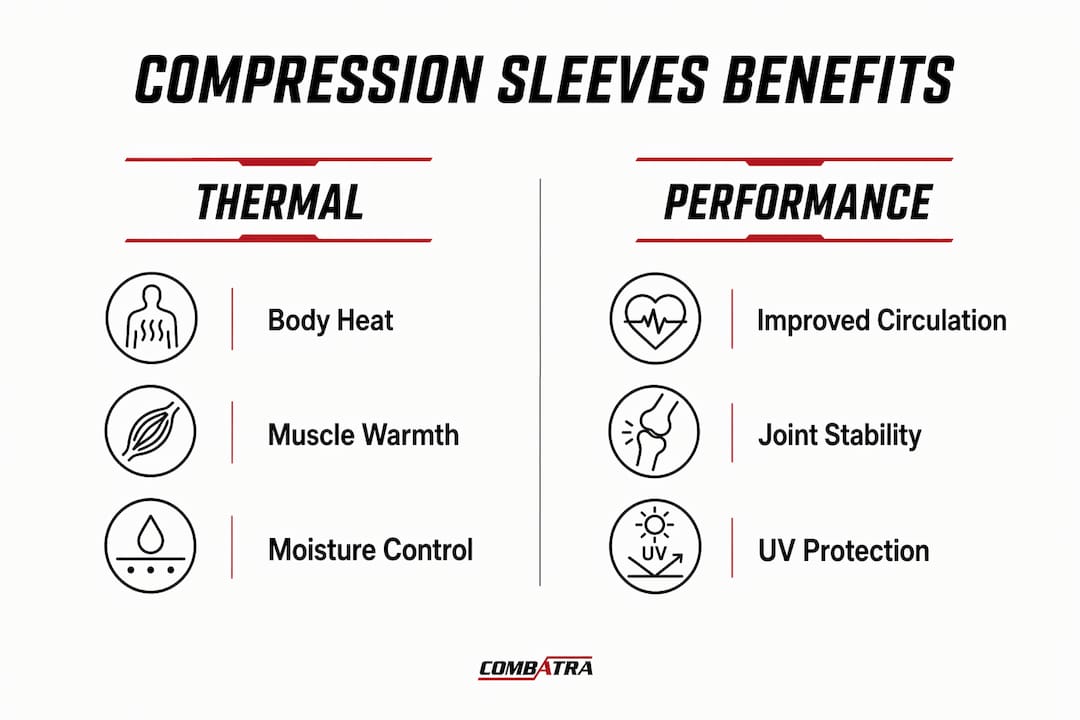
The thermal benefit comes from how the fabric sits against the skin. Polyester blends excel at moisture evaporation and maintaining compression, while merino wool offers superior thermoregulation and odour resistance for longer sessions. Dual-layer constructions trap heat and wick sweat simultaneously, which is exactly what you need when your warm-up generates heat but the air temperature is still single digits.
Cold weather also creates a specific physiological problem for athletes: muscle tremors and joint stiffening. Compression sleeves reduce micro-vibrations and stabilise joints, which helps maintain motor control and grip strength in freezing conditions. That is not a minor benefit. Stiff, poorly warmed muscles are a primary cause of cold-weather injuries.
The modularity of sleeves is their most underrated feature. You can remove or stash a pair of arm sleeves in under 10 seconds during training. That speed of adjustment avoids the disruptive cycle of overheating under a full thermal layer, then stripping it off and going cold again.
Pro Tip: Wear your sleeves from the start of your warm-up, then remove them once your core temperature stabilises. Tuck them into a waistband or pocket rather than leaving them on the ground.
Layering strategies for variable Australian conditions
Australian winter conditions vary sharply between regions and even within a single training session. A morning run in Canberra in july starts near freezing and warms quickly once the sun rises. Arm sleeves paired with a short-sleeve rashguard give you a layering system for cold training that adapts in real time.
The key principle is to start slightly cool rather than fully warm. If you begin a session overdressed, you will overheat before your muscles are fully activated. Sleeves let you start with adequate warmth and shed the layer precisely when your body no longer needs it.
What are the performance benefits beyond warmth?
Graduated compression is the core mechanism that separates arm sleeves from simple thermal wear. Graduated compression applies the most pressure at the wrist and eases progressively toward the bicep. This pressure gradient drives venous return, pushing blood back toward the heart more efficiently and reducing lactic acid accumulation in the muscles.
The physiological effects are measurable. Studies show that compression sleeves improve muscle hemodynamics by enhancing blood flow and tissue oxygenation during strenuous activity. Better oxygenation means muscles fatigue more slowly and recover faster between efforts. For combat sports athletes doing repeated high-intensity rounds, that recovery window is critical.
Cold conditions amplify the value of these benefits. When temperatures drop, blood vessels constrict to preserve core body heat. That vasoconstriction reduces blood flow to the arms and hands, slowing reaction time and weakening grip. Compression sleeves counteract this by mechanically supporting circulation in the limb, keeping the muscles warmer and more responsive.
The performance benefits of compression sleeves in cold weather include:
- Reduced muscle fatigue: Improved venous return clears lactic acid faster between rounds or intervals.
- Joint stabilisation: 360-degree stretch fabric reduces muscle vibration, protecting tendons and joints from cold-induced stress.
- Enhanced proprioception: Warming cold-sensitive joints improves your body’s awareness of limb position, which directly supports technique and injury prevention.
- UV protection: Premium sleeves rated UPF 50+ block harmful UV rays, which remain a real risk during outdoor training in Australia even in winter.
- Abrasion resistance: Sleeves protect skin during ground work, grappling, or contact with rough outdoor surfaces.
Pro Tip: If you train BJJ or MMA outdoors, choose sleeves with a UPF 50+ rating. Winter sun in Australia still delivers significant UV exposure, particularly between 10am and 2pm.
How do compression sleeves compare with other cold weather training apparel?
Choosing between compression arm sleeves, rashguards, base layers, and thermal tops depends on your sport, the temperature range, and how much your intensity varies during a session. Each option has a clear use case.
| Feature | Compression arm sleeves | Rashguard (long sleeve) | Thermal base layer |
|---|---|---|---|
| Warmth | Moderate, targeted | Moderate, full coverage | High, full coverage |
| Moisture management | Excellent | Excellent | Good |
| Mobility | Full range of motion | Full range of motion | Moderate |
| Ease of adjustment | Remove in under 10 seconds | Cannot remove mid-session | Cannot remove mid-session |
| UV protection | UPF 50+ available | UPF 50+ available | Limited |
| Suitability for combat sports | High | High | Low |
Rashguards and compression sleeves are the closest comparison. A long-sleeve rashguard provides full arm coverage and is the better choice when temperature stays consistently cold throughout a session. Arm sleeves win when temperature varies, because you can adjust on the fly without interrupting training. For combat sports, sleeves also avoid the bulk that a full thermal layer adds under a gi or rash top.
Thermal base layers are designed for sustained cold exposure, not high-intensity sport. They trap too much heat during hard efforts and cannot be removed quickly. For most outdoor training sessions in Australian winter, they are the least flexible option.
The best approach for variable conditions is to combine a short-sleeve rashguard with compression arm sleeves. You get full arm coverage at the start of a session and the option to strip back to short sleeves as your body temperature rises. This combination also works well under a gi jacket for BJJ athletes training in unheated dojos during winter.
How to use and care for compression arm sleeves in cold weather
Selecting the right sleeve starts with compression level. Light compression suits casual training, recovery walks, and low-intensity outdoor sessions. Medium compression is the standard choice for running, cycling, and most gym-based training. High compression is appropriate for heavy lifting, contact sports, and sessions where joint stabilisation is a priority.
Fabric choice follows climate. For temperatures below 10°C, a merino wool blend or dual-layer polyester construction provides the best balance of warmth and moisture management. For mild winter days above 15°C, a single-layer polyester blend is sufficient and avoids overheating.
Follow these steps to get the most from your sleeves across a full training season:
- Put sleeves on before warming up. Cold muscles need thermal support from the first movement, not after you have already started generating heat.
- Smooth out any bunching at the elbow. Uneven fabric reduces compression effectiveness and can cause pressure points during extended sessions.
- Remove sleeves when you feel consistently warm. Do not wait until you are sweating heavily. Removing them slightly early prevents heat buildup.
- Wash after every session in cold water. Heat degrades elastic fibres and reduces compression over time. Machine wash cold, gentle cycle.
- Air dry only. Tumble drying breaks down the compression fabric faster than any other factor.
- Replace sleeves when they no longer feel snug. Stretched-out sleeves provide little compression benefit. If they slide down during activity, they have lost their functional life.
Caring for compression wear correctly extends the garment’s effective lifespan significantly. Most quality sleeves maintain their compression properties for 6–12 months of regular use with proper care.
Key takeaways
Compression arm sleeves work in cold weather because they combine targeted thermal regulation, graduated compression, and modular adjustability in a single lightweight garment.
| Point | Details |
|---|---|
| Temperature regulation | Sleeves trap body heat to prevent stiffness while allowing quick removal to avoid overheating. |
| Graduated compression | Pressure from wrist to bicep improves venous return, reducing lactic acid and muscle fatigue. |
| Cold-weather performance | Sleeves reduce muscle tremors and improve proprioception in freezing conditions, lowering injury risk. |
| Modular advantage | Sleeves can be removed in under 10 seconds, making them more adaptable than full thermal layers. |
| UV protection | UPF 50+ rated sleeves protect against Australian UV exposure even during winter outdoor training. |
The thing most athletes get wrong about arm sleeves
The most common misconception I see is that compression arm sleeves are purely a warmth tool. Athletes either wear them all session regardless of intensity, or they skip them entirely because they think a rashguard covers the same ground. Neither approach is right.
The real value of arm sleeves is in their adaptability. I have trained with athletes who overheat badly in the second half of a session because they refuse to shed a layer mid-drill. Arm sleeves solve that problem completely. You strip them off in seconds, tuck them away, and keep moving. No interruption, no performance dip.
What I have also noticed is that athletes underestimate the cold-induced tremor problem. When your hands and forearms are cold, your technique suffers before you even realise it. Grip weakens, reaction time slows, and joint control deteriorates. Sleeves address all of that directly by keeping the muscles warm and mechanically supported. That is not a marginal gain. For combat sports athletes, it is the difference between training well and training poorly in winter.
My advice is to experiment with timing. Try wearing sleeves for the first 15 minutes of your next cold-weather session, then remove them once you are fully warm. You will notice the difference in how quickly your arms feel ready to work.
— McGinnis
Train smarter in the cold with Combatra
Combatra builds performance gear for athletes who train hard regardless of the season. The range includes compression arm sleeves, UPF 50+ rashguards, and full combat sports apparel designed for movement, breathability, and durability in real training conditions. For BJJ athletes, the Combatra black BJJ gi jacket pairs directly with compression sleeves for cold-weather dojo sessions. If you train karate or MMA outdoors, the custom black rashguard rated UPF 50+ gives you full arm protection with the compression benefits covered in this article. Browse the full Combatra range to find gear matched to your sport and your conditions.
FAQ
Do arm sleeves actually keep you warm during training?
Compression arm sleeves trap body heat close to the skin to prevent muscle stiffness in cold conditions. They also regulate temperature by facilitating heat dissipation during high-intensity effort, preventing dangerous heat spikes.
Should you wear compression sleeves for outdoor winter training?
Yes. Compression sleeves stabilise joints, improve circulation, and reduce cold-induced muscle tremors, all of which directly support performance and injury prevention during cold weather training.
How do compression sleeves differ from a thermal base layer?
Compression sleeves provide targeted pressure and can be removed in under 10 seconds mid-session. Thermal base layers offer more overall warmth but cannot be adjusted during activity, making them less suitable for variable-intensity training.
Can compression arm sleeves protect against UV in Australian winter?
Premium compression sleeves rated UPF 50+ and tested to AS 4399:2020 block harmful UV rays effectively. Australian winter sun still delivers significant UV exposure, particularly during midday outdoor sessions.
How long do compression arm sleeves last with regular use?
Quality compression sleeves maintain their functional compression for approximately 6–12 months of regular use when washed in cold water and air dried after each session. Replace them when they no longer feel snug or begin sliding during activity.