


TL;DR:
- UV radiation poses year-round risks in Australia, with many regions having a UV Index of 3 or higher during winter. Protective measures like UPF 50+ clothing, sunscreen, and UV-blocking eyewear are essential to prevent skin and eye damage. Most outdoor athletes unknowingly neglect winter sun protection, increasing their long-term health risks.
UV protection is defined as the practice of shielding skin and eyes from ultraviolet radiation, and in Australia it remains a year-round medical necessity, not a summer-only habit. For outdoor athletes, BJJ competitors, and anyone training outside, the risk does not disappear when temperatures drop. Large parts of Australia, including regions north of Perth and Brisbane, record a UV Index of 3 or above throughout winter. That threshold is the point at which skin damage begins. Rashguards built to AS 4399:2020 and rated UPF 50+ are one of the most practical tools an athlete can use to manage that risk during outdoor sessions. Understanding why UV protection still matters during Australian winter starts with knowing how UV radiation actually behaves when the air turns cold.
Why UV protection still matters during Australian winter
Temperature and UV radiation are separate phenomena. Cold air does not reduce UV intensity. The UV Index measures the strength of ultraviolet radiation reaching the earth’s surface, and Australian government data confirms that many regions maintain a UV Index of 3 or above during winter months. A reading of 3 is the recognised threshold at which sun protection becomes necessary.
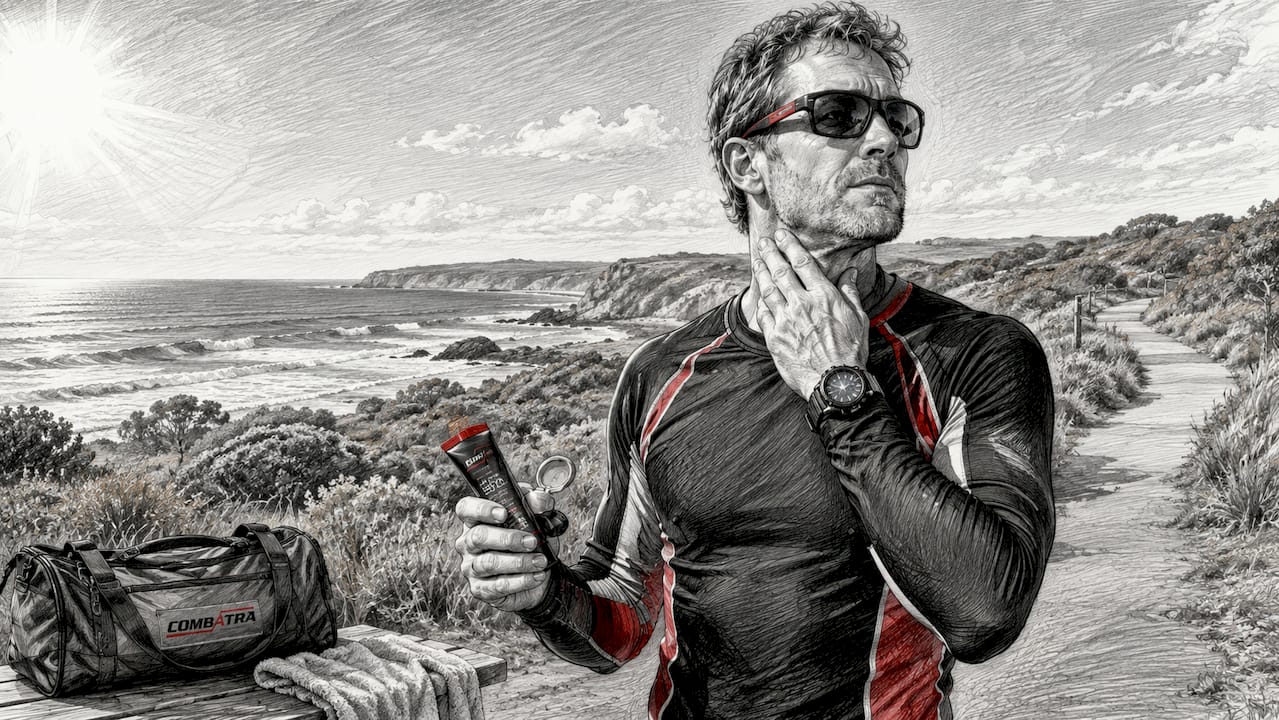
Two types of UV radiation drive this risk: UVA and UVB. UVB is the ray responsible for sunburn and is more variable by season and latitude. UVA, however, penetrates clouds and glass year-round. UVA causes up to 90% of visible skin ageing and reaches deep into the dermis regardless of cloud cover or temperature. That means a cool, overcast winter morning in Melbourne still delivers a meaningful UVA dose to any exposed skin.
Cloud cover creates a false sense of security. Clouds filter some UVB but block very little UVA. On a heavily overcast winter day, UV radiation can still reach 80% of its clear-sky intensity. Athletes training on outdoor courts, fields, or open water are exposed for extended periods without realising it.
The winter sun angle adds another layer of risk that most people overlook. In winter, the sun sits lower in the sky. That lower angle means UV radiation strikes the face and eyes more directly during morning and afternoon periods. The low winter sun angle increases direct UV exposure to the face and eyes precisely when most outdoor training sessions take place.
Reflective surfaces compound the problem further. Snow, wet sand, concrete, and glass all reflect UV radiation back upward. Reflective surfaces can increase total UV exposure by up to 80%. An athlete training on a concrete surface in winter is receiving UV radiation from both above and below simultaneously.
| Season | Typical UV Index (southern Australia) | Typical UV Index (northern Australia) | Protection required |
|---|---|---|---|
| Summer | 10–14 (extreme) | 12–16 (extreme) | Yes, maximum |
| Autumn | 5–8 (high) | 8–12 (very high) | Yes |
| Winter | 2–4 (low to moderate) | 5–8 (high) | Yes, north of Perth and Brisbane |
| Spring | 6–10 (high to very high) | 9–13 (very high) | Yes, increasing rapidly |
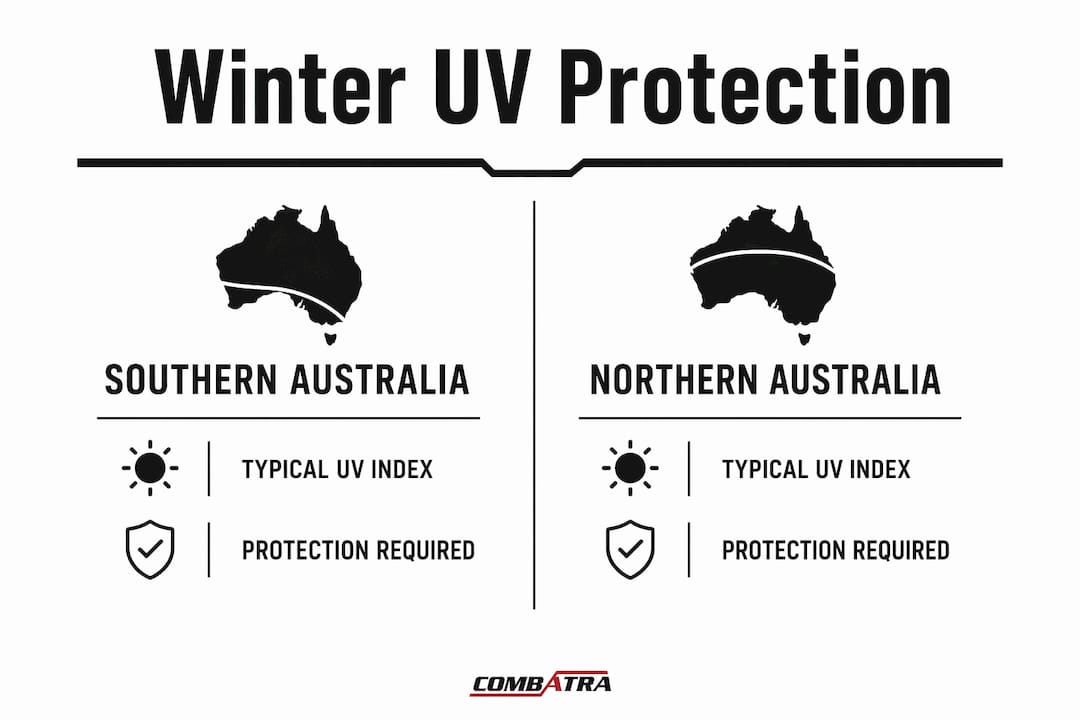
Pro Tip: Check the UV Index on the ARPANSA SunSmart app before each outdoor session. If the reading is 3 or above, apply sun protection regardless of how cold it feels.
What does winter UV exposure actually do to your skin and eyes?
The damage from winter UV exposure is real, and most of it is invisible until years later. UVA radiation causes collagen breakdown in the dermis, leading to premature ageing, pigmentation changes, and loss of skin elasticity. UVA radiation causes 80–90% of visible ageing and operates independently of season or temperature. That means every winter training session without protection adds to a cumulative total your skin will eventually show.
UVB causes direct DNA damage to skin cells, increasing the risk of skin cancer over time. The latency period for UV-related skin cancer is typically 10–30 years. Damage accumulated during years of winter outdoor training may not manifest as a clinical problem until well into middle age.
Winter conditions also weaken the skin’s natural defences. Cold, dry air strips skin moisture, weakening the lipid barrier that normally helps protect against UV damage and environmental inflammation. A compromised skin barrier absorbs UV radiation more readily and recovers more slowly. For athletes who train daily, this creates a cycle of repeated exposure on already-vulnerable skin.
The eyes are equally at risk. Photokeratitis, sometimes called snow blindness, is a UV burn of the cornea. It can occur in winter without snow, simply from prolonged exposure to reflected UV off concrete or water. Chronic UV exposure to the eyes is also linked to cataracts and macular degeneration over time.
Here are the key winter-specific health risks from UV exposure that outdoor athletes face:
- Photoageing: UVA-driven collagen breakdown accelerating wrinkles and pigmentation
- Skin cancer risk: Cumulative UVB DNA damage building over decades of unprotected exposure
- Compromised skin barrier: Winter dryness increasing UV absorption and inflammation
- Photokeratitis: UV burns to the cornea from reflected winter light
- Chronic eye damage: Long-term UVA exposure linked to cataracts and macular degeneration
- Scalp and lip exposure: Often missed areas during winter when hats and lip balm with SPF are skipped
Pro Tip: Use a moisturiser with SPF 30 or above during winter. It supports the skin barrier and delivers UV protection in one step, which is particularly useful for athletes who train early in the morning.
Do Australians actually protect themselves from the winter sun?
The short answer is no, and the data makes that clear. 46% of outdoor workers skip sunscreen entirely in winter, treating sun protection as a seasonal behaviour rather than a daily one. That figure represents a significant portion of the outdoor workforce accepting cumulative skin damage without realising it.
The problem goes beyond attitude. Sunscreen application in practice is frequently inadequate. Most people do not apply the correct thickness or reapply at the recommended two-hour interval. The standard test dose for sunscreen is 2 milligrams per square centimetre of skin. In practice, most people apply less than half that amount, which reduces the effective SPF significantly.
The following mistakes are common among outdoor athletes and workers during winter:
- Relying on SPF in daily moisturisers, which typically contain SPF 15 and are not applied thickly enough to deliver that rating
- Skipping sunscreen on overcast days based on the incorrect assumption that clouds block UV
- Applying sunscreen after going outside rather than 20–30 minutes before, reducing its effectiveness
- Neglecting the back of the neck, ears, and hands during outdoor training
- Not wearing UV400-rated sunglasses, leaving the eyes unprotected during morning and afternoon sessions
- Removing protective layers mid-session when temperatures rise, exposing skin that was previously covered
Only 8.7% of outdoor workers adequately use sun protection, and that group faces a 60% higher risk of non-melanoma skin cancers. The gap between knowing sun protection matters and actually doing it consistently is where most of the long-term damage occurs.
How to protect yourself from UV rays in Australian winter
Effective winter sun protection combines multiple methods. No single approach covers every exposure scenario for an active person. The most reliable strategy layers UPF-rated clothing, dedicated sunscreen, protective accessories, and behavioural adjustments.
UPF 50+ clothing as your first line of defence
UPF 50+ clothing offers reliable, set-and-forget UV protection that sunscreen alone cannot match for prolonged outdoor activity. A rashguard rated UPF 50+ and tested to AS 4399:2020 blocks over 98% of UV radiation on covered areas. It does not wash off, does not need reapplication, and does not degrade over a two-hour session. For athletes training outdoors in BJJ, MMA, or general fitness, a quality UPF-rated rashguard is the most consistent form of protection available.
Sunscreen: application and reapplication matter
Apply SPF 30 or SPF 50+ sunscreen to all exposed skin 20–30 minutes before going outside. Reapply every two hours during extended sessions. Mineral sunscreen provides additional defence against pollution and visible light, which is particularly relevant during winter when the skin barrier is already weakened by cold, dry air. Do not rely on SPF in a moisturiser as your primary protection during outdoor training.
Eye and head protection
UV400-rated sunglasses block both UVA and UVB across the full UV spectrum. Wear them year-round, particularly during morning and afternoon sessions when the low winter sun angle increases direct UV exposure to the face and eyes. A broad-brimmed hat adds coverage for the scalp, ears, and back of the neck. If you train in a helmet or safety gear that prevents a hat, apply sunscreen to those exposed areas before putting on your equipment.
| Protection method | UV coverage | Practical for athletes | Needs reapplication |
|---|---|---|---|
| UPF 50+ rashguard | Covered areas only, 98%+ block | Yes, excellent | No |
| SPF 50+ sunscreen | All exposed skin | Yes, with discipline | Yes, every 2 hours |
| UV400 sunglasses | Eyes only | Yes | No |
| Broad-brimmed hat | Face, neck, scalp | Moderate | No |
| Combined approach | Full body coverage | Yes, optimal | Sunscreen only |
Pro Tip: Combine a UPF 50+ rashguard with SPF 50+ sunscreen on exposed areas like the face, neck, and hands. This covers the gaps that clothing alone cannot reach and removes the need to reapply sunscreen to your torso during training. You can read more about preventing sunburn outdoors in Combatra’s athlete guide.
Key takeaways
UV protection during Australian winter is non-negotiable because UV radiation reaches skin-damaging levels year-round across most of the country, regardless of temperature or cloud cover.
| Point | Details |
|---|---|
| UV Index 3+ persists in winter | Many Australian regions record damaging UV levels throughout winter, requiring active protection. |
| UVA operates year-round | UVA causes up to 90% of visible ageing and penetrates clouds and glass regardless of season. |
| Skin barrier weakens in winter | Cold, dry air compromises the lipid barrier, making skin more vulnerable to UV damage. |
| Most Australians under-protect | 46% of outdoor workers skip sunscreen in winter, accumulating decades of silent UV damage. |
| Layered protection works best | Combining UPF 50+ clothing, SPF 50+ sunscreen, and UV400 eyewear delivers full coverage. |
Winter UV risk is the one athletes consistently underestimate
I have spent years working with outdoor athletes and combat sports competitors across Australia, and the pattern I see most often is not ignorance of sun safety. Most athletes know sunscreen exists. The problem is that winter creates a psychological blind spot. Cold air feels protective. It does not feel like a day you need to worry about UV.
What I have observed is that the athletes who develop the most significant photoageing and skin concerns are not the ones who trained through summer without sunscreen. They are the ones who trained through winter without it, year after year, assuming the risk was low. The cumulative dose from years of unprotected winter sessions is substantial, and it shows up on the skin long after the training is done.
The other thing I have learned is that sunscreen alone is not a realistic solution for athletes. Application is inconsistent, reapplication during a session rarely happens, and sweat degrades coverage quickly. UPF 50+ rashguards tested to AS 4399:2020 solve that problem on covered areas completely. They are the most reliable protection tool available to an active person, and they work identically in winter and summer. The athletes who treat sun protection as part of their kit, not an afterthought, are the ones who come out ahead in the long run.
— McGinnis
Train protected with Combatra’s UPF 50+ gear
Combatra builds performance rashguards and compression wear specifically for athletes who train outdoors year-round in Australian conditions. Every rashguard in the range is rated UPF 50+, tested to AS 4399:2020, and designed for the demands of BJJ, MMA, and outdoor training sessions where sun exposure is unavoidable.

The gear is built for movement, breathability, and long-duration wear, so protection does not come at the cost of performance. Whether you are training through a Brisbane winter or a Perth summer, Combatra’s custom UPF rashguards deliver consistent, set-and-forget coverage on every covered area of your body. Browse the full range at Combatra and make sun protection a permanent part of your training kit, not just a summer habit.
FAQ
Do I need sunscreen in Australian winter?
Yes. Many Australian regions record a UV Index of 3 or above throughout winter, which is the threshold at which sun protection is medically recommended. Apply SPF 30 or above to all exposed skin before going outside.
Can UV rays damage skin on cloudy winter days?
Yes. Clouds block some UVB but very little UVA. On an overcast day, UV radiation can still reach up to 80% of its clear-sky intensity, meaning skin and eye damage remains possible without protection.
Is UPF clothing better than sunscreen for outdoor athletes?
UPF 50+ clothing is more consistent than sunscreen for covered areas because it does not wash off, degrade with sweat, or require reapplication. Sunscreen remains necessary for exposed areas like the face, neck, and hands.
What UV Index requires sun protection in winter?
A UV Index of 3 or above requires sun protection. Australian government data from ARPANSA confirms that regions north of Perth and Brisbane regularly reach this threshold during winter months.
How does winter affect skin’s vulnerability to UV damage?
Cold, dry winter air strips moisture from the skin and weakens the lipid barrier, making skin more susceptible to UV-related inflammation and photoageing than it would be during warmer, more humid months.